

Insights from FlytBase CEO Nitin Gupta: How AI, Drones, and Robots Are Reshaping Energy Operations
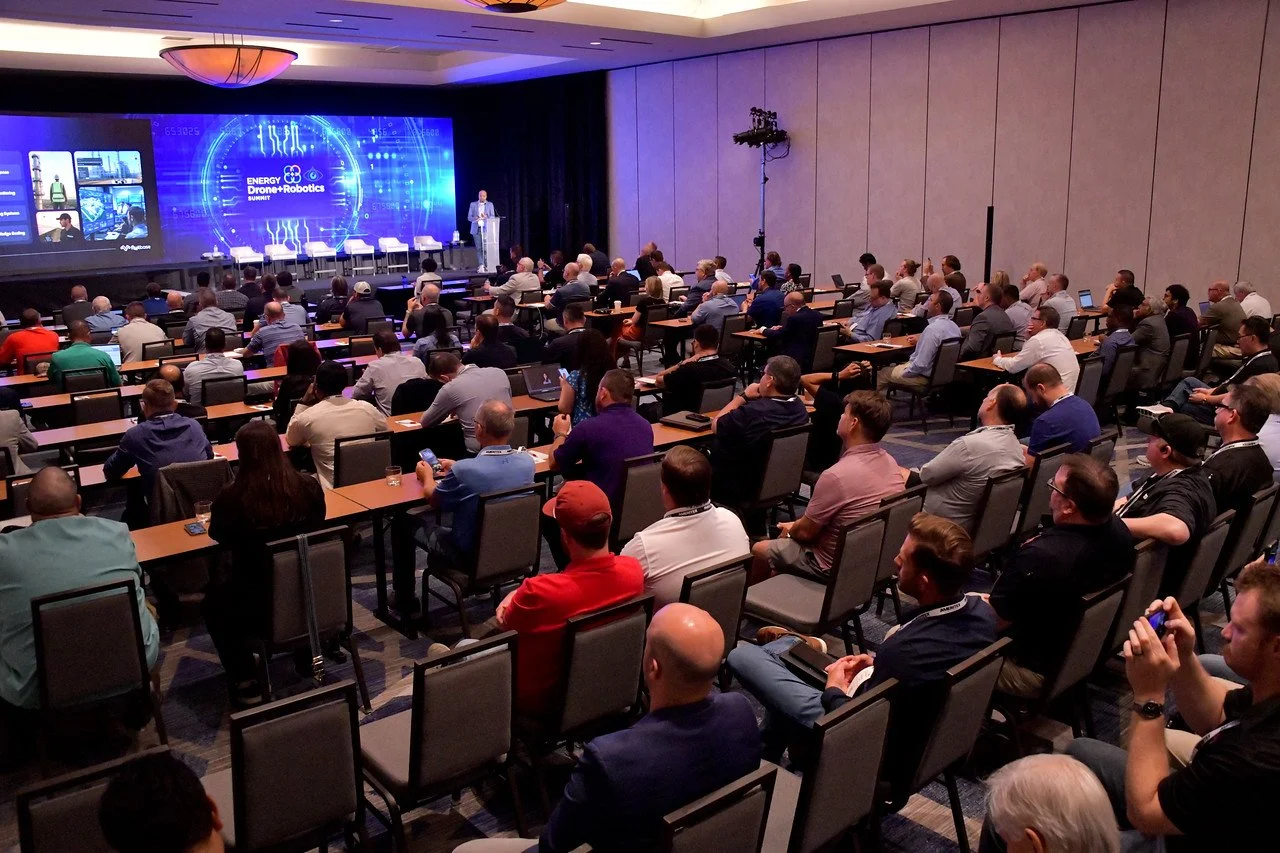
/At the 2025 Energy Drone & Robotics Summit, Nitin Gupta, Founder and CEO of FlytBase, took the stage to deliver a clear message: “The moment of convergence is here.” His session, titled How AI, Drones & Robots Are Taking Over Energy Operations, offered a deep dive into the powerful intersection of artificial intelligence, autonomous systems, and industrial domain expertise—and what it means for the energy sector right now.
Here’s a recap of the session, which you can watch on-demand here. And keep reading for an exclusive Q&A with Gupta.
From Hype to Real-World Transformation
“The question no longer is, will AI be useful for my site? Of course it will be,” Gupta stated. “Now the only question is how fast can we adopt it?”
Gupta emphasized that recent advancements, particularly in generative AI, are not just incremental—they’re transformative. In fact, he cited a McKinsey report estimating that generative AI alone could unlock $390-$550 billion in additional value.
The key difference now? “All this value will not be distributed equally,” Gupta warned. “There will be some companies who will move fast—who will be able to do that transformation—and others will lag behind.”
Three Forces Fueling the Shift
Gupta broke down the "moment of convergence,” which are these three pieces that were all separate and only recently are coming together.
1. Edge AI
“This has happened very recently,” Gupta explained. “We have very advanced AI models that are very lightweight that can be deployed on edge infrastructure… so you can really harness this power at the edge.”
2. Autonomous Systems
It’s no longer just about data insights. “How do you actuate in the real world?” Gupta asked. “Today we have robotic dogs and of course drones, very capable drones with very capable payloads.” Being able to connect AI intelligence with these technologies—and having these advanced systems that are safe, reliable, and can work on physical sites—becomes very important.
3. Domain Expertise
Third, Gupta said, having AI understand your specific area of operation is important. “Now you can have small language models or specialized, fine-tuned models that can understand your domains and really work very closely with you to solve those complex problems.”
Real Impact, Not Just POCs
Gupta acknowledged that while predictive maintenance, drone inspections, and robotics have been discussed for over a decade, the industry is finally seeing broad, scalable adoption.
“The concept of living systems or living software has now become possible,” he said, referring to AI systems that improve over time via reinforcement learning. “You don't have to send any humans to dangerous locations. We now have dog drones and autonomous ground robots that can get the job done.”
He shared a compelling case study from Plant Services Magazine, in which a major oil and gas company saved $10 million by preventing a single compressor failure—part of a broader potential $800 million annual impact across offshore sites.
Urgency Is Rising
Why the pressure to adopt now? According to Gupta, the drivers are clear:
Workforce Crisis: “50% of our workforce will retire in the oil and gas industry in the next five to 10 years. And this is something that you cannot just fix by hiring.”
Regulatory Pressure: “There are stringent norms that need to be followed, and it's becoming harder and harder to catch up with traditional methods.”
Economic Squeeze: “Renewable energy is creating a lot of pressure on O&G margins, so we need much more efficient ways of delivering results.”
And while many organizations still hesitate, Gupta stressed that “these are not really technical issues… they are trust issues.”
From Resistance to Adoption: How to Make It Work
To overcome adoption barriers, Gupta advised a three-pronged approach:
Security: Use edge processing and open-source, air-gapped models to ensure private data stays on-site. “You don't have to rely on public infrastructure… everything can be contained within your premise.”
Workforce Transition: Focus on workforce elevation instead of disruption, co-creating AI solutions with existing staff.
Legacy Systems: “Work with systems that are already there and augment them with AI. Use data that is already being collected by systems you already have within your enterprise.”
A Call to Collaborate—and Move Fast
Gupta ended his talk with a clear directive: “The window is closing. We see the next 24 to 36 months as a very critical period where we have to work very aggressively to make all this technology and translate it into real benefits.” He encouraged energy professionals to initiate conversations about their real-world challenges and opportunities and explore how AI and robotics can address them—today.
“We need to think of it as two important things: domain expertise and AI expertise,” he said. “This is amazing power that cannot be unlocked by either of these two alone.”
Behind the Keynote: A Conversation with Nitin Gupta
After we were all settled back home after EDRS, we sat down with Nitin Gupta for a one-on-one conversation led by Sean Guerre, Executive Director of the Energy Drone & Robotics Coalition. Here’s an excerpt from that discussion, which expanded on Gupta’s session in exploring the practical realities of AI and robotics adoption in energy operations.
Questions and answers have been edited for length and clarity.
Sean Guerre: During your keynote, you talked about how most of FlytBase’s deployments have accelerated in the last two years. What’s driving that rapid adoption, especially in critical infrastructure?
Nitin Gupta: There are two big shifts we’ve seen. One is on the hardware side. A few years ago, deploying a drone used to be quite time-consuming—there were a lot of hardware issues, different systems coming together for the first time. But now, these systems have become really sophisticated and reliable. That’s changed the game.
The second shift is in AI. Previously, we could only use basic algorithms—photogrammetry, stitching images together—but the systems we have now are almost magical in how well they can understand large, complex industrial sites. AI can now deliver detailed, nuanced understanding of inspections, security, and compliance issues. That level of insight just wasn’t possible, even six months ago. So, it’s the convergence of more refined hardware and these amazing AI capabilities that’s driving transformation.
Sean Guerre: For energy companies that are still early in their AI and robotics journey, what are the first steps they should take?
Nitin Gupta: The first step is to start conversations—especially between energy domain experts and AI experts. The energy folks know the problems really well, and the AI folks know the capabilities of the technology. When those groups collaborate, that’s when real solutions emerge.
And this is not a matter of “if” anymore. It’s a matter of “when.” AI is moving at warp speed. A lot of these capabilities are already mature. It can already help us implement so many things that were just not possible earlier. So the sooner we start these conversations, the better we will be equipped to start leveraging this technology and continue to remain at the front as more and more capabilities continue to become available.
Sean Guerre: What are some of the key things to get going on something like this and start running at least pilot projects.
Nitin Gupta: So many of these large companies that used to take a long time to make decisions now realize that things are moving so fast and that there is enormous ROI that can be realized with technology that is already available. So it's no longer incremental. It is no longer 10% improvement, 20% improvement. We are talking about several orders of magnitude improvement—like 10x improvement. It's massive.
That is why there is that urgency—because the sooner you adopt it, the sooner you can be far ahead of the industry and of your competitors and. With adoption of AI, ROI can be massive and that is why it is not something that you can delay. It has to start ASAP.
Sean Guerre: You mentioned that kind of ROI in your keynote—like the $800 million case study. What metrics are your clients using to track the impact of AI?
Nitin Gupta: That case study was from Plant Services Magazine—a single compressor failure that was predicted and prevented, which saved $10 million. Across offshore sites, the potential impact was $800 million annually. But beyond cost savings, clients are looking at predictive capabilities—can you spot failures before they happen? Can you respond to emergencies faster? Can you free your workforce from dangerous jobs or put them on higher value work?
Sean Guerre: FlytBase takes a hardware-agnostic approach. How do you ensure seamless integration with so many different drones and robotics systems?
Nitin Gupta: A lot of the industry is moving toward standardization—standard APIs that allow us to send commands to robots and receive data in return. We’re also seeing protocols like MCP (Model Context Protocol), which make it easier to interface with a wide variety of systems.
On top of that, we work with integration partners in over 40 countries—across the U.S., Europe, the Middle East, and Southeast Asia. These partners help us deploy and integrate with many different types of hardware.
Sean Guerre: Cybersecurity is always top of mind, especially for energy asset owners. How does FlytBase address data privacy and edge processing concerns?
Nitin Gupta: This is one of the biggest concerns for our customers—especially with AI models. Companies are worried their enterprise data might get used to train public models, or go outside their organization.
For cloud-based applications, we meet all the standard certifications—SOC 2 Type 2, GDPR, ISO 27001. But for most of our enterprise AI deployments, we do everything on-premise. These are completely air-gapped, with firewalls in place. Nothing leaves the premises.
The good news is that very high-quality open-source models are now available. We fine-tune those models using the client’s data and deploy them entirely on their own servers. So their data stays private, secure, and fully contained.
Sean Guerre: Looking ahead a few years, what’s the next major breakthrough or trend you see in this space?
Nitin Gupta: The pace of change right now is incredible. If you follow what’s happening in AI and robotics, especially among the tech community, you’ll see there’s a huge amount of excitement—and for good reason. The future we’re imagining now is one where operations are completely AI-enabled.
We may not get there in two or three years, but it’s no longer a vision that’s 100 years away. Whether it’s 10, 15, or 20 years, most people agree that we’re heading toward a world where systems are increasingly autonomous and robotic. There are projections that we could have a billion humanoids in the next 10 years—and within 20 years, potentially more humanoids than humans.
Of course, we’ll get there layer by layer. At first, we’ll be collecting and understanding data, generating insights, and supporting decision-making. But as systems learn—by observing how we make decisions and how our sites operate—they’ll gradually take on more complex tasks.
The real goal is having robotic systems that not only understand their environments but also make business-aligned decisions and take action. Eventually, these systems will help free human workers from dull and dangerous jobs and handle more of the heavy lifting—literally and figuratively—while continuously improving over time. That’s the direction we’re headed.
Final Thoughts
Gupta’s keynote and follow-up conversation leave no doubt: the transformation is already underway. With the convergence of AI, reliable autonomous systems, and deep domain knowledge, energy companies now have the tools to rethink how they operate—at scale, with speed, and with intelligence.
As Gupta put it: “The revolution is here—let’s work together and harness it for our physical sites.”
Now’s the time to move from conversation to collaboration—and from planning to implementation.
Keep learning:
Watch this and other EDRS sessions on-demand
Watch the full Q&A video
Block off June 22-24, 2026, for the 10th annual EDRS
