

The Post-Print Revolution: How Impac Systems is Redefining UAV Airframes and Industrial Digital Twins
/The industrial and energy markets are dealing with a nasty one-two punch right now. Domestic and international shipping costs have jumped roughly 40% in recent months, and the cracks in global logistics aren't going away. At the same time, demand for specialized UAVs—for asset security, defense, and infrastructure monitoring—keeps climbing with no sign of slowing.
Additive manufacturing sits squarely in the middle of that pressure. The industry has spent years earning its reputation as a rapid prototyping tool. Now it's being asked to do something much harder: heavy-duty, localized volume production.
To get a ground-level view of where things stand, we talked with Kelly Knake, CEO and Principal of Houston-based Impac Systems. The company just hit its 10th anniversary as a Premier Platinum Hewlett Packard partner, and recently locked in the exclusive North American distributorship for Europe's Reinforce3D—a significant get in the post-print reinforcement space.
Knake walked us through how a post-printing fiber technique is producing plastic parts that behave like metal, why the energy sector is pushing toward hybrid manufacturing, and how scanning technology is making real-time digital twins practical in the field.
1. Rethinking UAV Airframes with Post-Print Reinforcement
EDRN: Impac recently partnered with Reinforce3D to bring their Continuous Fiber Injection Process (CFIP) to North America. For UAV manufacturers, how does injecting continuous carbon fiber post-print change airframe design—and can these parts actually replace CNC-machined aluminum?
Kelly Knake: It shifts the whole strength-to-weight equation. The old way of getting continuous fiber into an additive part meant embedding it layer-by-layer during the print itself. That killed design freedom, slowed everything down, and left structural voids you had to work around.
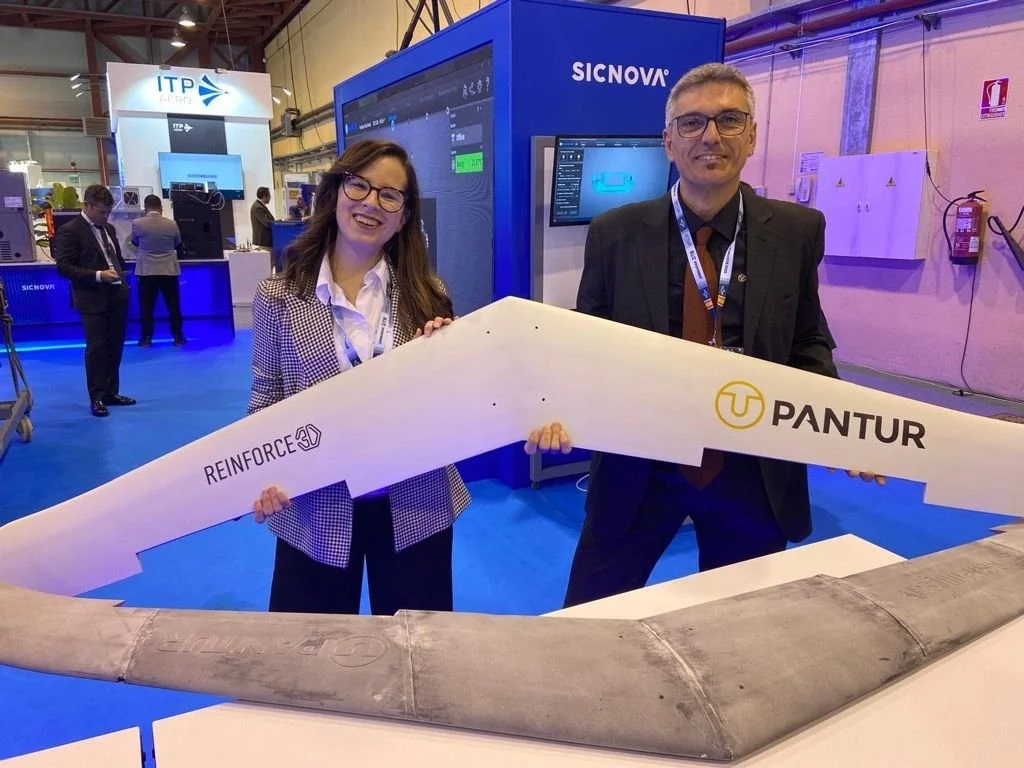
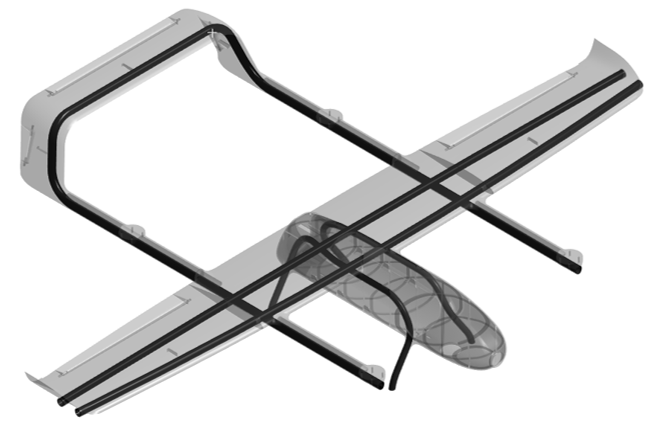
The Reinforce3D process sidesteps all of that. The machine is roughly the size of an airport luggage kiosk, and it runs a three-spool capacity of continuous carbon fiber, glass fiber, or Kevlar. We print hollow structural components with pre-engineered internal channels, then the machine mechanically injects continuous fibers and a two-part epoxy resin directly through those channels post-print.
The results hold up. In live demos, we show a seven-foot drone wing held together entirely by a continuous fiber core injected through this process—no traditional fasteners, no stress-concentration points. Cure time is either 24 hours at ambient or three to four hours in a 40°C oven. For high-stress UAV work, you get ultra-lightweight structural frames with metal-like rigidity, without the cost of CNC-machined aluminum or the labor intensity of autoclave carbon fiber layups.
2. What High-Performance Polymers Can—and Can't—Do in Energy Environments
EDRN: Operating out of Houston, you serve a harsh energy and industrial market. What advancements in polymers like PEEK or ULTEM are finally proving resilient enough to handle downhole pressures or offshore environments?
Knake: Oil, gas, and offshore wind are punishing—extreme heat, chemical exposure, and pressures that will find every weakness in a material. We run engineering-grade materials like PEEK, PEKK, and ULTEM on industrial platforms like the BigRep Ultra 280 for our core energy clients.
But let's be straight: additive manufacturing isn't a wholesale swap for metal. Metals still win when you need the highest temperature deflection or raw mechanical tensile strength. What's actually happening in the energy sector is a shift toward hybrid manufacturing. We use additive to create weight-optimized geometries that reduce fluid turbulence or structural load, then bring in subtractive CNC machining to finish critical sealing faces and high-tolerance threads. You get the corrosion resistance and weight savings of advanced polymers, combined with the reliability of traditional metal interfaces where it counts.
3. Getting 3D Printing Out of the R&D Lab
EDRN: What's holding Texas manufacturers back from moving 3D printing into automated, repeatable UAV production runs?
Knake: The machine capability isn't the problem anymore. The bottleneck is perception—too many executives still think of 3D printing the way it looked 15 years ago. Brittle consumer parts, toys, rough aesthetic models. That mental image is holding companies back from looking at what the technology actually does today.
The production numbers tell a different story. Through our decade-long work with Hewlett Packard's Multi Jet Fusion platform, the global network has printed over 300 million end-use production parts. A major Austin-based EV manufacturer and a well-known consumer tech company—let's just say it's named after a fruit—are both running industrial additive networks for actual scale production. They're not prototyping. They're making parts.
The defense and industrial drone market is a natural fit for this because requirements change constantly. A threat profile or operational spec that's valid today might be outdated in a month. Additive gives operators the ability to iterate, modify, and deploy hardened components in days instead of waiting months for an injection mold tool.
4. Local Production and the "Attritable" Drone Strategy
EDRN: With the rise of low-cost, attritable drones for security and industrial monitoring, how close are we to operators 3D printing mission-ready UAVs on-site and bypassing the traditional supply chain entirely?
Knake: We're already there. With shipping costs up 40%, depending on a centralized overseas manufacturing chain is a real operational and financial liability—not a theoretical risk. Additive manufacturing is a direct buffer against that volatility because production stays domestic and you're not at the mercy of container availability or port delays.
To make that concrete for our clients, we stood up a sister company called ThirdPoint Industries focused exclusively on end-to-end drone design, engineering, and manufacturing. The core idea is digital inventory: instead of warehousing millions of dollars in physical replacement parts, operators hold secure CAD and print files. If an asset inspection drone goes down on an offshore platform or a remote pipeline, the operator prints a structural, flight-ready frame on-demand, on-site. The traditional logistics pipeline is optional.
5. AI Design Tools and Field-Ready Digital Twins
EDRN: With your background in simulation and FEA, how is AI and reality capture changing your design workflow—and how do you validate complex geometries for safety?
Knake: The front end of the design pipeline looks nothing like it did a few years ago. HP's text-to-STL technology lets designers describe a component in plain language, and the AI translates that into a print-ready file. It's not perfect, but it meaningfully lowers the barrier to getting something into the design pipeline fast.
On the verification side, we're using the Artec 3D Jet—a 1.7-kilogram continuous scanner that mounts to a backpack, a truck, or directly onto an industrial UAV. Field engineers can scan an entire oil and gas facility or refinery in a fraction of the time it used to take. The Jet works within the same software environment as Artec's stationary and handheld scanners, and the output is a detailed digital twin that feeds directly into CAD and FEA suites.
From there, we run structural modifications, airflow simulations, and even automated gas leak detection. Any geometry that comes out of generative AI goes through rigorous digital stress-testing before a printer ever touches polymer. That validation step isn't optional—it's how we close the loop between AI-generated design and a part you can actually trust in the field.
See the Technology Live at EDR Summit
Impac Systems and ThirdPoint Industries will be exhibiting at the 10th Anniversary Energy Drone & Robotics Summit in Houston, June 22–24.
Attendees can get hands-on with the Reinforce3D CFIP kiosk, inspect the seven-foot continuous fiber drone wing, and view live data from the Artec 3D Jet.
