

$2 Billion Says Autonomous Construction Is Getting Real
/
From The Robot Report
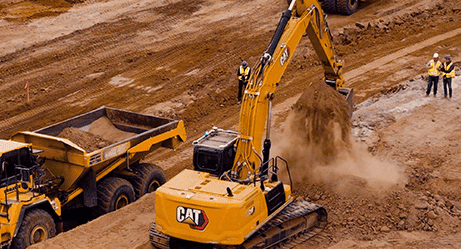
Nearly $2 billion. That’s how much money has poured into five companies working on autonomous heavy machinery since mid-July.
Apparently, investors have looked at excavators, haul trucks, and earthmoving equipment and said, “Here’s a very large check.”
The money is flowing, but it’s not all pointing in one direction. These companies have very different ideas about how autonomous construction should work.
Pick Your Autonomy
Companies like Bedrock Robotics, Gravis Robotics, and AIM Intelligent Machines are pursuing retrofits by adding sensors, cameras, and computing to equipment contractors already own.
Built Robotics specializes in autonomous pile driving for solar projects. Caterpillar reports nearly 700 autonomous mining trucks operating worldwide. Atoms, run by Uber cofounder Travis Kalanick, acquired Pronto after it had already hauled more than two million tons autonomously.
TerraFirma has a different plan: Don’t sell autonomous equipment to earthworks contractors. Become the earthworks contractor using its own remotely supervised machines.
These companies are in the same broad category, but they have very different relationships with customers.
Retrofitting makes autonomy something a contractor owns. Autonomy as a service turns it into something they hire. And TerraFirma could end up sitting across from contractors at the bid table.
It’s a bit like choosing between buying a power tool, hiring someone with the power tool, or discovering the power tool has submitted its own bid.
Follow the Data
There’s another reason all this money may be chasing heavy equipment.
Autonomous machines are multitaskers. They’re moving dirt and taking notes. They collect information about the physical world around them, including terrain, machine behavior, obstacles, people, and more.
That connects construction autonomy to the much bigger AI race.
Advanced Machine Intelligence raised more than $1 billion on the idea that AI needs a better understanding of the physical world. World Labs is pursuing a similar mission, garnering a $200 million investment from Autodesk to bring that technology into design software.
As the youths would say, AI needs to get out and touch grass…or, in this case, dirt.
Bigger Than Money
A giant fundraising round doesn’t automatically mean contractors are ready to hand over the keys. Especially if autonomous equipment doesn’t even have keys.
Most of the performance numbers coming from these companies are still self-reported, with little independent verification. And even if the technology works exactly as advertised, contractors still have to decide which model they trust, how it fits into existing operations, and who ultimately controls the capability.
Even if the money side of the equation is solved, the machines still need permission to get to work.
For a closer look at where the autonomy money is going, the companies competing for it, and what it could mean for the future of construction, check out the Bricks & Bytes Bulletin.
