

Beyond the Demo: What it Really Takes to Scale Industrial Robots
/
From GE Vernova
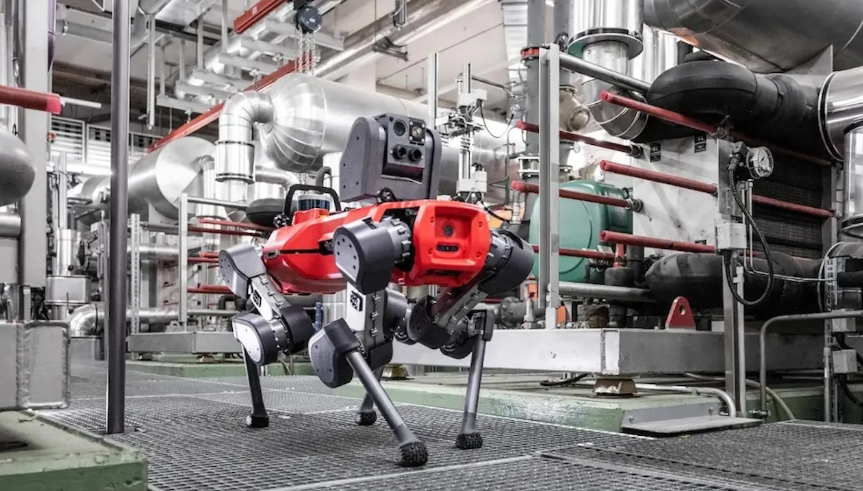
The "honeymoon phase" for industrial robots is ending. For years, we’ve been impressed by four-legged machines that can climb stairs or avoid obstacles. But for companies in oil, gas, and chemicals, a robot that "just walks" isn't helpful. It needs to be a tool that fits into a very dangerous world.
In a recent talk with Brian Heater on the Automated podcast, Péter Fankhauser, the CEO of ANYbotics, explained that the industry is hitting a turning point. We’re moving from testing one or two robots to deploying entire fleets. Here is what you need to know about the shift from lab toys to industrial workers.
The "Ex-Proof" hurdle
In a refinery or a chemical plant, you can't just walk in with a standard piece of electronics. If a battery shorts out or a motor sparks, it could be catastrophic. This is why "Ex-proof" (ATEX or IECEx) certification is so vital.
Building a robot that can walk is hard. Building one that is sealed so tightly it can operate in an explosive atmosphere is even harder. For asset owners, this isn't a "nice-to-have" feature. It’s the difference between a useful tool and a fire hazard.
Data is the real product
People get distracted by how robots move. They focus on the legs and the sensors. But the CEO of ANYbotics is clear: the robot is just a delivery system. The real value is the data.
When a robot walks through a plant, it’s constantly scanning for heat signatures, listening for acoustic anomalies (like a gas hiss), and reading gauges. The goal isn't just to "see" the plant; it's to turn those sights and sounds into a digital record that your maintenance team can actually use. If the data doesn't plug into your existing systems, the robot is just an expensive pet.
Dealing with "Pilot Purgatory"
Most companies get stuck in the pilot phase. They buy one robot, play with it for six months, and then it sits in a closet because nobody knows how to scale it.
To move past this, you have to treat the robot like a standardized piece of equipment. You need a clear plan for how it will be maintained, how the software will be updated, and who is responsible for the data it produces. Scaling isn't about buying more robots; it’s about building the processes to support them.
The "Dirty, Dull, and Dangerous" mission
The best use for these machines is still the "Triple D" work. We’re talking about tasks that are too boring for a human to do perfectly every time, or too dangerous for them to do at all.
An autonomous robot doesn't get tired of checking the same valve every four hours. It doesn't get distracted. And if there is a potential gas leak, you can send the robot in first to find the source. This keeps your people out of harm's way while giving you better information than a human could get on their own.
What’s coming next?
The future isn't about more sensors. It's about higher levels of autonomy. We’re moving toward a world where the robot doesn't just follow a path—it understands the environment. If a new piece of equipment is in the way, it figures out a new route. If it sees something strange, it flags it for a human to review.
The goal is to make these machines so easy to use that you don't need a PhD to run them. They should be just another tool in the technician’s belt.
The EDR News Takeaway: Stop looking for robots that do tricks. Look for machines that have the certifications to survive your site and the software to handle your data. The companies that win the next decade won't be the ones with the "coolest" tech—they'll be the ones with the most reliable data.
