

How 3D Printing is Revolutionizing Drone Manufacturing: A Conversation with Impac Systems Engineering
/
The drone industry stands at an inflection point. While unmanned aerial systems have proven their value across energy infrastructure and pipeline inspection, manufacturers face a persistent challenge: how to scale production while maintaining the customization and agility these applications demand. The answer, according to Kelly Knake of Impac Systems Engineering, lies in additive manufacturing.
In a recent conversation for the Energy Drone & Robotics Coalition, Knake shared insights from nearly four decades of experience in mechanical engineering and 3D printing, revealing how additive manufacturing is transforming drone production from prototype to production.
From Rapid Prototyping to Production-Ready Parts
Impac Systems Engineering has witnessed the evolution of what started as "rapid prototyping" into today's sophisticated additive manufacturing ecosystem. Now approaching 40 years in business and based in Houston and Central Texas, the company has assembled a network of advanced manufacturing vendors capable of producing parts in both metals and polymers.
"Traditional manufacturing will never go away," Knake emphasizes. "This is a way to allow you to utilize additive for what's best. It is a tool. Utilize it for that."
That tool now includes the capability to print in stainless steel, titanium, and aluminum—materials that prove particularly valuable for drone applications where the strength-to-weight ratio is critical.
Customization at Scale: Why Drones Need Additive Manufacturing
The drone industry's maturity level creates a perfect use case for 3D printing. Unlike consumer products manufactured by the hundreds of thousands, industrial drones—whether VTOL (vertical takeoff and landing) models or fixed-wing platforms—are produced in smaller quantities with high customization requirements.
"They want them to be a particular model, whether they are a VTOL that they can go ahead and take off vertically and then fly horizontally," Knake explains. "And they're not making tens of thousands of these. So they want to make them in a very customizable type way. And that's where the additive can come in."
This customization extends beyond aesthetics. Drone manufacturers need to accommodate different motors, optimize aerodynamic profiles, and tailor designs for specific missions—whether monitoring gas pipelines or supporting fracking operations. Additive manufacturing enables rapid iteration without the prohibitive cost of creating new molds for each design variation.
Just-In-Time Manufacturing: Speed to Market
Perhaps the most compelling advantage of 3D printing for drone manufacturers is the dramatic reduction in time to market. Knake describes additive manufacturing as enabling "just-in-time manufacturing"—producing exactly what's needed at the specific time it's needed.
"I can get to market in days and weeks rather than months," Knake notes. This speed advantage serves multiple purposes throughout the product lifecycle.
For startups and established companies alike, rapid prototyping accelerates the design validation process. Engineers can test five different configurations, evaluate performance, and refine designs without the weeks or months required for traditional manufacturing methods. Once the optimal design is validated, companies face a choice: transition to traditional manufacturing for high-volume production or continue with additive manufacturing for mid-volume production runs.
"If they're not going to be producing a quantity of tens of thousands, they actually can do it in production where we're doing additive as a production," Knake explains, highlighting how 3D printing has evolved beyond prototyping into a viable production method.
Advanced Materials: Metal Drones That Fly
One of the most significant misconceptions about 3D printing involves material limitations. When most people think of metal components, they imagine heavy, bulky parts unsuitable for aircraft. Knake dispels this notion with practical examples.
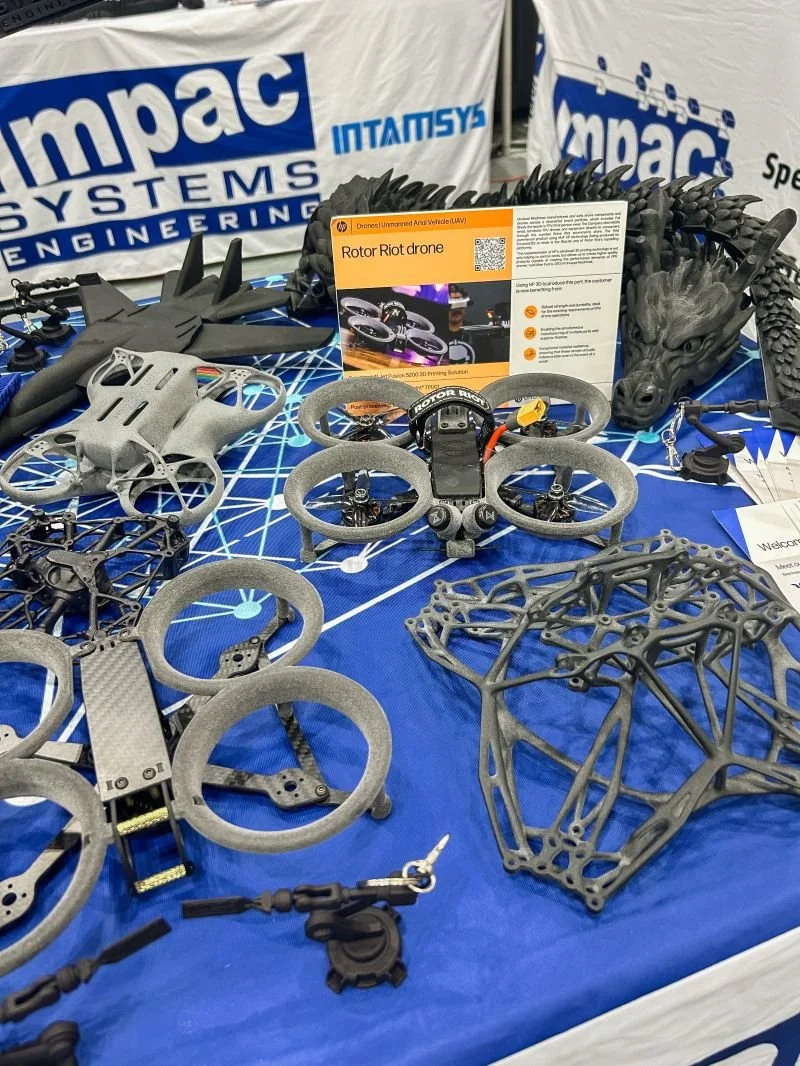
Impac Systems Engineering works with vendors including Hewlett Packard for polymer components and One Click Metal for metal parts. They've successfully produced aluminum drone frames that are both durable and lightweight enough for flight operations with cameras and sensors.
"We have a drone flying a small aluminum frame with cameras and everything else," Knake confirms. "So it's a great tool for what it's used for."
The material options extend from aluminum to titanium and stainless steel, with applications spanning far beyond drones—from sporting goods and firearms to prosthetics—demonstrating the versatility of modern additive manufacturing.
The Strategic Advantage: Supply Chain Independence
Recent global events and shifting trade policies have elevated supply chain resilience from operational concern to strategic imperative. Knake points to recent statements from military leadership advocating for increased 3D printing adoption, particularly for forward-deployed operations where traditional supply chains become liabilities.
"The head of the US Army came out recently and said we need to have more 3D printing because think about it, they're on the front line. They're away from the supply chain. They might be in offshore or rugged territory," Knake explains. "So they need a part and they need it quickly and they need it customized."
This principle applies equally to commercial drone operations in remote energy infrastructure locations. Service companies operating in challenging environments can potentially maintain 3D printing capabilities on-site, enabling rapid replacement of damaged components without waiting for parts to ship from distant manufacturing facilities.
The current climate around tariffs and international trade further strengthens the case for domestic additive manufacturing. "Better to be made in America," Knake argues. "I'm not having to wait on a foreign entity to produce it and I'm also keeping my intellectual property internally rather than going out."
Protecting Innovation: The IP Advantage
For drone manufacturers developing proprietary technologies, intellectual property protection represents a critical concern. Traditional overseas manufacturing arrangements often require sharing detailed designs with third-party manufacturers, creating potential IP exposure.
Additive manufacturing enables companies to maintain tighter control over their innovations. By keeping production domestic and in-house, manufacturers reduce the risk of design theft or unauthorized reproduction. As Knake puts it, companies avoid "letting your children play in the street"—keeping valuable IP secure while simultaneously reducing costs and accelerating time to market.
Accelerating Investment and Market Entry
Beyond operational benefits, 3D printing serves a crucial role in securing funding and attracting investors. Entrepreneurs seeking capital for drone ventures can leverage additive manufacturing to produce functional prototypes and proof-of-concept models that demonstrate their vision tangibly.
"I want to show my investors what my final product's going to look like because they want to know where their money is going," Knake explains. A professionally produced 3D-printed prototype carries far more persuasive power than CAD renderings or verbal descriptions, potentially accelerating the path from concept to funded venture.
Looking Ahead: The Future of Additive Manufacturing in Drones
As the energy and industrial drone sector continues to mature, additive manufacturing appears positioned to play an expanding role. The technology addresses fundamental industry needs: customization, rapid iteration, supply chain resilience, and IP protection.
For manufacturers contemplating whether to adopt 3D printing, Knake's perspective offers clarity: treat additive manufacturing as one tool in a comprehensive manufacturing strategy. It excels at specific applications—low to medium volume production, high customization requirements, rapid prototyping, and situations demanding supply chain agility.
Companies like Impac Systems Engineering serve as bridges, connecting drone manufacturers with the expanding ecosystem of metal and polymer printing vendors, materials scientists, and design engineers who understand how to optimize parts for additive production.
As military and commercial organizations increasingly recognize the strategic value of distributed manufacturing capabilities, and as material science continues advancing the strength, weight, and performance characteristics of printed components, 3D printing's role in drone manufacturing seems likely to expand rather than contract.
For the energy drone and robotics industry, the message is clear: additive manufacturing has evolved from an interesting novelty into a production-ready technology offering tangible competitive advantages. The question for manufacturers is no longer whether to explore 3D printing, but how quickly they can integrate it into their design and production workflows.
Kelly Knake and the Impac Systems Engineering team will be presenting at the Energy Drone & Robotics Forum on November 12th at the ION in Houston, Texas, where attendees can explore additive manufacturing solutions firsthand.
