

How ExxonMobil Is Building its Digital Reality Ecosystem (DRE)
/
From Honeywell
At Industrial IMMERSIVE 2025, ExxonMobil’s Kyle Daughtry and Athicha “M” Dhanormchitphong offered an insider’s view of the company’s journey to transform how it visualizes, manages, and uses data across assets, departments, and the globe.
In their session, “DRE: Digital Reality Ecosystems for Energy Assets & Data: Now and Next,” the duo explained how the Digital Reality Ecosystem (DRE) program is helping ExxonMobil create a unified, data-driven view of its operations—and why that requires more than just choosing the right platform.
“With ExxonMobil, we’ve got sites all over the world, so we’ve got a bit of a challenge on how do we make sure that when we deploy these platforms, it’s at corporate scale and integration,” said M.
So rather than try to standardize on a single software stack, the team focused on something deeper: harmonizing the data itself.
Not Just a Digital Twin
While many companies are racing to implement digital twins, ExxonMobil’s team is careful not to reduce the DRE to a single definition. Instead, they see it as a way to connect all data types—spatial, visual, operational—into an open, modular ecosystem.
“Digital twin’s not software,” Kyle emphasized. “It’s a culmination of a bunch of data and information.”
To make that work, the team is separating data from the software platforms used to capture, store, and visualize it.
“You want to own that data,” M said. “You’re going to see tons of platforms that continue to come out. Take that data out if you need to, take it onto the next platform to get what you need.”
The Pillars of DRE
ExxonMobil's approach is built on four pillars that guide how data flows through the ecosystem:
Capture: Democratize data collection, from advanced scans to smartphones in the field
Store: Centralize storage, separate from any specific vendor software
Deliver: Make data accessible anytime, anywhere, to those who need it
Consume: Ensure data is consumable based on the use case, whether training, inspection, or design
“You've got a phone in your pocket right now that is powerful enough to capture a lot of information out in the field,” said Kyle. “But if I go out there just utilizing it without any types of standards, all I’m doing is creating a data mess.”
To avoid that, the team has developed standards and guardrails for capturing and managing reality-based data—information about what assets really look like and where they are.
Layering the Physical and the Digital
A key goal of DRE is combining layers of reality capture with models and metadata for a unified, spatially accurate digital environment.
M explained it this way: “Let’s say I’ve got a scan of this podium, but at the same time, there’s probably some type of metadata I want to establish a relationship to, like the manual or the manufacturer. In our world, it's project maintenance, risk data, and things like that. We want to tie those relationships, so we make the data available, we overlay it, we connect it, and we visualize it.”
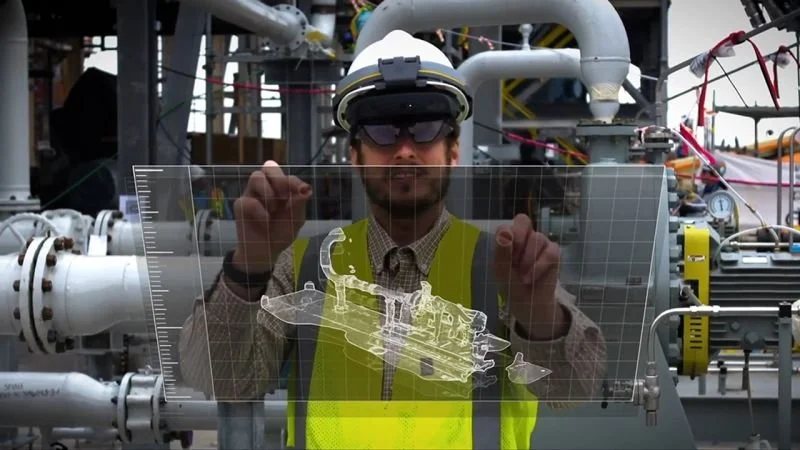
This enables the team to overlay CAD models, drone imagery, laser scans, and operational data to support use cases like:
Project design and validation
Turnaround planning and logistics
Enhanced visual inspections
AI-driven anomaly detection
Augmented field procedures
Immersive training
Drone images of equipment are tied to specific coordinates and overlaid with metadata so engineers know exactly what they’re looking at and where. They can use this data to make decisions. For example, planning to put temporary cranes in a location and being able to see ahead of time if they're actually going to fit.
Meaningful Operations at Scale
Many of ExxonMobil’s early immersive use cases focused on training and design, but Kyle noted the next frontier is breaking into operations and maintenance in a meaningful way—at scale.
“How do you actually figure out how to break it into operations in a meaningful way? Not just a really cool technology, but in a meaningful way. At scale.”
To get there, they’re working to reduce barriers—cost, interoperability, and complexity—and foster more industry collaboration.
A Call to Action for the Industry
ExxonMobil’s DRE journey hasn’t happened in isolation. The team actively participates in cross-industry groups like the ARC Advisory Council and the Digital Twin Consortium.
Kyle emphasized the importance of industry collaboration: “It’s not a problem that a single company is going to solve at the end of the day.”
That’s why they’ve helped form the Open Asset Digital Twin Group, with participation from major operators like Shell, Chevron, BP, Dow, and BASF.
One major outcome so far?
“There is alignment that the cost to maintain a digital twin is too high right now,” Kyle said. “And there’s a lack of understanding and expertise and skills within 3D models.”
To help, ExxonMobil is preparing to publish its reality capture standards and guardrails for industry-wide use—an effort designed to help others replicate and scale the approach.
Reality First
If there’s one takeaway from ExxonMobil’s digital reality journey, it’s this: start with the real world.
“Reality first,” Kyle said. “What is in reality now? A model’s going to contribute to reality. A laser scan is going to contribute to reality. The data from an engineering tool is going to contribute to reality. All of it in the same space and time.”
By separating software from data and anchoring everything in physical reality, ExxonMobil is laying the foundation for scalable, interoperable digital ecosystems—designed for what’s now and what’s next.
Access this and other Industrial IMMERSIVE sessions on demand.
