

Industrial Digital Twins Grow Up: Building Enterprise Data Workflows from Reality Capture to AI
/The industrial world has never been better at capturing reality. Thanks to drones, robots, mobile mapping systems, laser scanners, 360-degree cameras, and drone-in-a-box deployments, organizations today can collect detailed representations of their facilities faster and more affordably than ever before. But as capture technologies mature, the conversation is shifting. The challenge has become transforming that data into an enterprise asset that improves decision-making across an organization.
That evolution was the focus of the panel discussion, "Industrial Digital Twin, Reality Capture & Data Workflows: Building From Data Capture to Model at Scale," during the 2026 Industrial Digital Reality Summit at InnovateEnergy Week. Moderated by Kelly Watt, the discussion featured the following panelists:
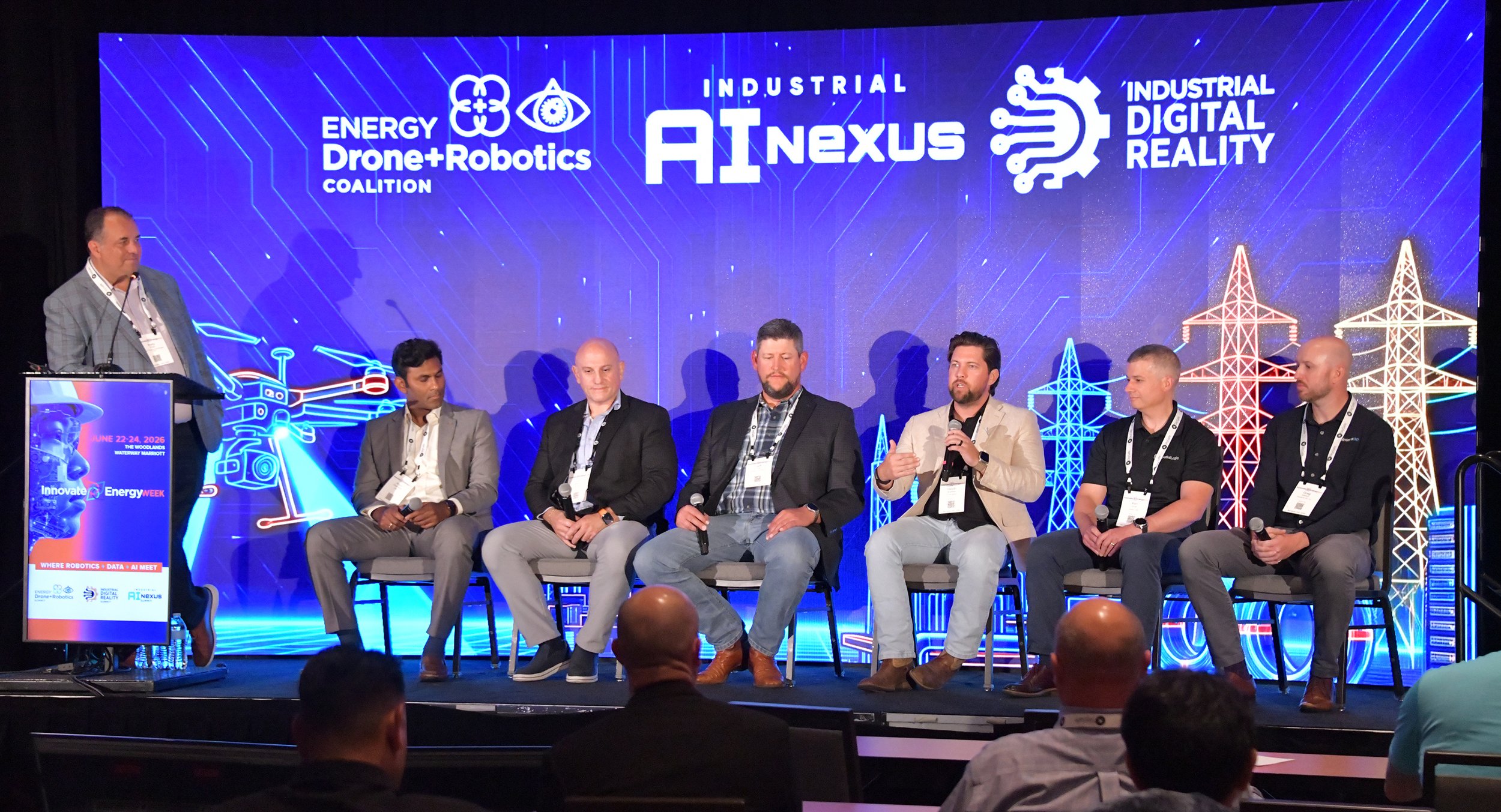
Haydn Bradfield of DroneDeploy
Arjun Devarapalli of KBR
Jeff Gray of Strategy Engineering
Greg Itzstein of Pointerra US
Eli Maftoum of Bentley Systems
Ken Smith of Spatial Logic
A large panel, full of insights. Each panelist brought a different perspective, and they repeatedly returned to one central message: industrial organizations need to stop thinking about reality capture as individual projects and start treating it as an enterprise-wide data strategy.
Not Projects, But Programs
Reality capture has traditionally been tied to individual engineering or construction projects. A facility is scanned to support a renovation, expansion, or inspection, then the resulting point cloud often sits unused once the project concludes.
Kelly Watt challenged attendees to rethink that approach. "We still work in a project-based world," he said. “But when you're in oil and gas, you have a lot of these projects going on all the time. So when are we going to move from project to program and to enterprise and start to think about this data as an asset for the organization??
That shift from project to program became the thread that connected nearly every discussion throughout the session.
Jeff Gray noted that it’s a hard shift for the people working on these projects. “The capture speed of the devices is faster. The processing of the software happens much faster. We're able to deliver via these new cloud-based platforms and make everything more accessible. For me, the biggest challenge around all of this is getting the end users to actually consume the data.”
In years past, reality capture projects often concluded with a hard drive delivered to a customer's office, only for it to sit untouched. Cloud-based platforms have dramatically improved accessibility, but organizations still need to make reality data easy for stakeholders to consume.
Reality Capture as a Foundation
Several panelists argued that reality capture has fundamentally changed the way digital twins can (and should) be built. Rather than creating a digital twin around engineering models alone, organizations increasingly start with reality itself.
Greg Itzstein explained that making reality capture easier and more accessible allows it to become the foundational layer upon which historical records, engineering information, GIS data, and operational information can all be connected. He said, “The actual reality data being the foundation layer makes decisions so much richer.”
Gray agreed, noting that engineering models rarely represent current conditions with complete accuracy. "What you were looking at isn't exactly what you should be looking at to make informed decisions,” he said. “Reality capture solves that problem."
Eli Maftoum added that improvements in computing power, cloud infrastructure, affordability, and user adoption have all accelerated this transition. "The mindset of people changed," he observed. "They're seeing more value in this."
Arjun Devarapalli added that being able to use the data is just as important as capturing it. “It's very important to leverage the data that you capture. That's where the value comes in because data is a backbone for the AI to function well.”
Start With the Business Problem
As technology expands, it's tempting to collect as much data as possible simply because it is now easier to do so. The panel cautioned against that mindset.
Instead of beginning with choosing a capture technology, organizations should first define the business outcome they're trying to achieve. Whether the goal is identifying corrosion, prioritizing maintenance, or assessing asset health, the desired answer should determine the workflow—not the other way around.
Haydn Bradfield explained that users ultimately aren't interested in millions of data points. They want to know whether they need to take action. "It's actually like, in its simplest, people are lazy," he joked. "They want a yes or no answer. Do I need to look at it or not?"
That philosophy has changed how DroneDeploy develops products. Rather than simply applying AI to existing workflows, Bradfield described working backward from the business question, then redesigning processes to deliver the most useful answer, even if it means capturing fewer, but better, images.
Clean Data Makes AI Possible
If one topic rivaled digital twins for discussion time, it was data quality. Every panelist acknowledged AI's enormous potential, but they also agreed that AI is only as effective as the data it receives.
Devarapalli emphasized that data serves as the backbone of AI and stressed that organizations must first clean and organize their information. "Garbage in, garbage out," he said.
He recommended establishing connected data environments where information is contextualized with metadata. That creates what he described as a "single source of truth," allowing everyone to access trusted information appropriate to their role.
Without that foundation, AI cannot reliably generate meaningful recommendations.
The Hidden Value of Raw Data
Many organizations view raw reality capture data as something to process once before archiving or deleting. Ken Smith encouraged attendees to think differently. He argued that today's raw capture data may become significantly more valuable as AI models continue improving.
"The AI that you're using today is the worst it's ever going to be," he said, suggesting that future algorithms will likely extract insights from existing datasets that simply aren't possible today.
Instead of treating raw imagery or point clouds as disposable project artifacts, organizations should preserve them as long-term assets. Cloud storage and lower storage costs make that increasingly practical, while future AI applications may unlock entirely new value from information captured years earlier.
Building Living Digital Twins
The panel also challenged a common misconception about digital twins. Many organizations still equate a digital twin with a 3D model or photorealistic visualization. The panelists argued that visualization is only one component.
A true digital twin combines visual context with engineering data, maintenance history, work orders, inspections, telemetry, and operational information to support better decisions. Itzstein described this as a "living digital twin" that evolves continuously rather than remaining static after a project concludes.
He said this is relevant “particularly in veg management where you're cutting and trimming on a pretty regular cycle. You can collect more data and constantly monitor where the risk is now.”
Maftoum echoed that vision. “You want a living digital twin that's an exact copy of what's out in the field,” he said. “We want everything to be in one place, a central source of truth, so executives can make an informed decision based on the information they have in front of them.”
The goal of digital twins is creating a continuously updated operational resource.
Governance Matters
As reality capture expands across the enterprise, panelists acknowledged that data governance becomes increasingly important. Industrial facilities often contain information that cannot be shared without oversight.
Smith illustrated the challenge with an early reality capture project with a customer. When reviewing the data, Smith said the customer’s face went white as they said, “You just captured the whiteboard that has not only our secret sauce, but also the plan for deployment. You can never share this with anyone ever again. Tell me about your IT Security.”
That experience reinforced the need for role-based access and thoughtful security planning.
Greg Itzstein said, “Data governance right at the start of projects or programs is key. Having that set at the front end so the right people are accessing the right data and the right insights makes a difference to how successful programs are.”
At the same time, Gray cautioned against creating too many data silos that information gets lost. He shared an example: “I've been on a site where I show up two weeks after somebody else has already scanned the same area. And it's for the same company, just in a different department.”
Successful enterprise programs must balance security with accessibility.
Technology Partnerships
Another recurring theme was collaboration between technology providers and end users.
Bradfield argued that software companies build better products when product managers spend time in the field asking questions. "It's really rooted in everything I've learned from people that have told me what they want. How do I create something that's going to work for them?"
Maftoum shared a similar philosophy: “We're working closely with different clients in many industries. Our goal is always to make things easier and faster for our users.”
Itzstein likewise described Pointerra's customer focus: “Every enhancement into our platform has been customer driven. We really focus on what our customers want to do and what we can do to help them as they grow and do more with their assets.”
The consensus was clear: successful digital transformation depends on strong technology partnerships.
Practical Value Today, Greater Value Tomorrow
The panel also discussed how organizations are already seeing measurable returns from reality capture.
Gray likened reality capture to insurance, explaining that accurate scans dramatically reduce costly field rework by enabling prefabricated components to fit correctly the first time.
Smith cited renewable energy projects where reality capture documents equipment condition before installation, helping quickly resolve questions about responsibility if damage occurs later.
Itzstein pointed to utilities that initially collected data for vegetation management and later reused the same datasets for asset management, clearance analysis, and additional operational purposes—effectively multiplying the return on a single capture effort.
Maftoum said customers are increasingly using AI-enabled inspections to detect infrastructure issues earlier, reduce downtime, improve maintenance planning, and keep workers out of hazardous environments.
As the discussion concluded, the panelists returned to the same idea that opened the session: Reality capture is no longer an emerging technology or a specialized engineering tool.
"It's an essential tool in your toolkit," Smith told attendees
For organizations pursuing digital twins, AI, or enterprise asset management, success will come from building processes, governance, partnerships, and data strategies that allow reality capture to become a long-term enterprise asset.
As Itzstein summarized, organizations that elevate reality capture from isolated projects to repeatable enterprise programs can transform one-time project expenses into data assets that continue delivering value across the business for years to come.
Watch this recording and more now! (Included for FREE if you were a VIP attendee at IE Week, simply reach out for the link!)
